
Long-Term Capital Gains Tax in India: A Guide for Investors
Holding periods • LTCG tax rates • Calculation • Exemptions
When an investment grows in value, it is easy to focus on the profit. But what happens when you decide to sell it?
The answer depends on the investment, how long you have held it and the tax rules that apply. Understanding long-term capital gains and capital gains tax can help you estimate your tax liability and plan your next financial move, whether you invest in equity shares, mutual funds or property.
In this guide
What Are Long-Term Capital Gains (LTCG)?
Suppose you bought shares, a mutual fund or a property and its value increased over time. When you sell that asset with a profit, the gain may be taxable.
This profit is called a capital gain. When the asset meets the required holding period under tax rules, it may qualify as a long-term capital gain (LTCG).
The distinction matters because short-term and long-term gains can be taxed differently, which is why understanding capital gains tax is important for every investor.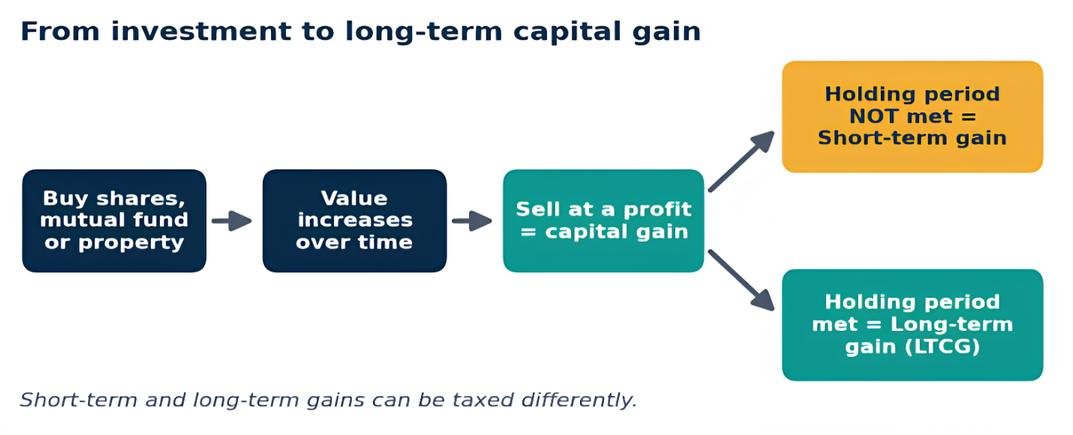
Source: Income Tax Department — Tax on Long-Term Capital Gains
When Does an Investment Become Long-Term?
Holding Period for Equity Shares, Mutual Funds and Land and Buildings
The holding period is not the same for every asset.
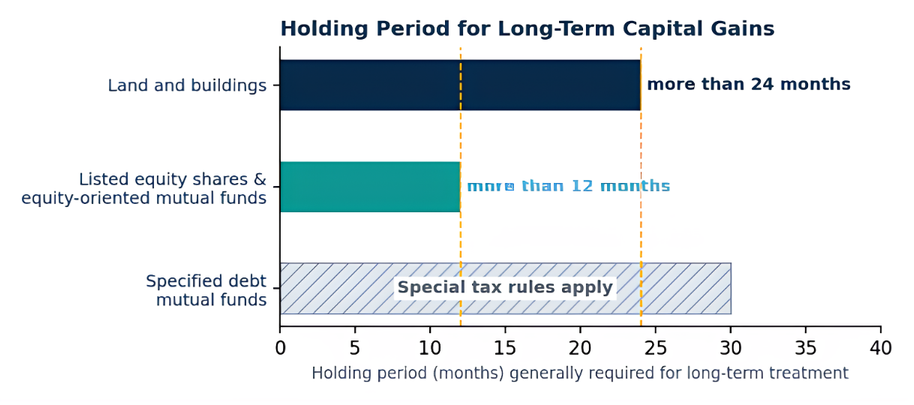
For example, listed equity shares and equity-oriented mutual funds generally qualify as long-term when held for more than 12 months. Land and buildings, including a residential property, generally require a holding period of more than 24 months.
Some investments, including specified debt mutual funds, follow special tax rules. Therefore, holding an investment for a longer period does not automatically mean it will receive long-term tax treatment.
Source: Income Tax Department — Tax on Sale of Shares
LTCG Tax Rates Across Different Assets
Long-Term Capital Gains Tax Rates in India
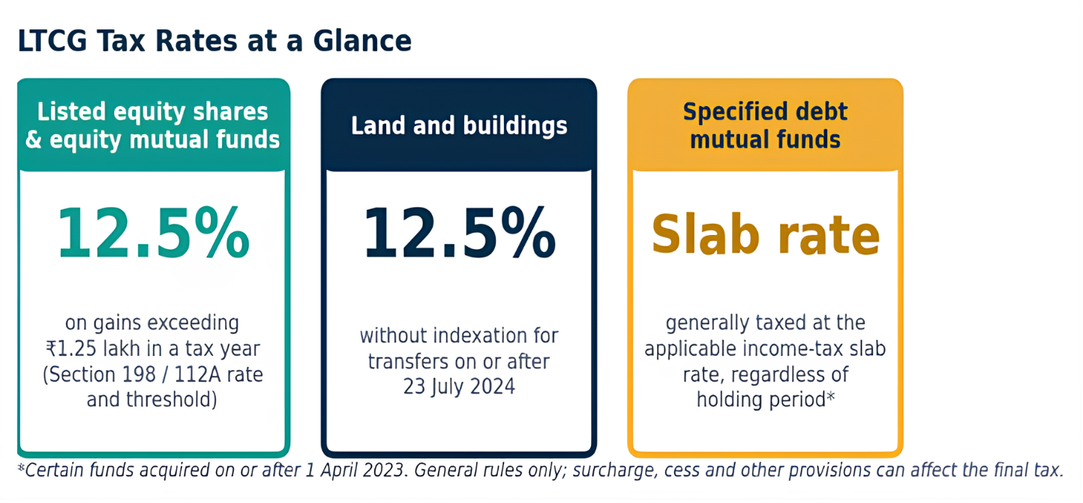
The tax you pay depends on what you sell and the provisions applicable to that investment.
| Investment | General tax treatment |
|---|---|
| Listed equity shares | Qualifying LTCG under Section 198 is taxed at 12.5% on gains exceeding ₹1.25 lakh in a tax year. |
| Equity mutual funds | Generally, follow the same Section 112A rate and threshold, subject to conditions. |
| Land and buildings | Generally, taxed at 12.5% without indexation for transfers on or after 23 July 2024. Eligible resident individuals and HUFs selling certain properties acquired before that date may qualify for a comparison with the earlier tax calculation under section 197(3). |
| Gold and other assets | Tax treatment depends on the asset, its holding period and the applicable provisions. |
| Specified debt mutual funds | Certain funds acquired on or after 1 April 2023 are subject to special rules under which gains are generally taxed at the applicable income-tax slab rate, regardless of holding period. |
| Category I AIF | Generally follows pass-through taxation for eligible income, except business income, which is taxed at the fund level. |
| Category II AIF | Generally follows the same pass-through framework as Category I AIFs. Business income is taxed at the fund level, while other eligible income retains its character and is taxed according to the applicable rules. |
| Category III AIF | Does not receive the same statutory pass-through treatment. Taxation depends on the fund’s legal structure and the nature of its income. |
Sources: Income-tax Act, 2025 — Section 197, Section 198, and Income Tax Department — Capital Gains.
LTCG Tax Collections in India: Key Facts and Figures
Official figures show how quickly long-term capital gains tax collections have grown in recent years.
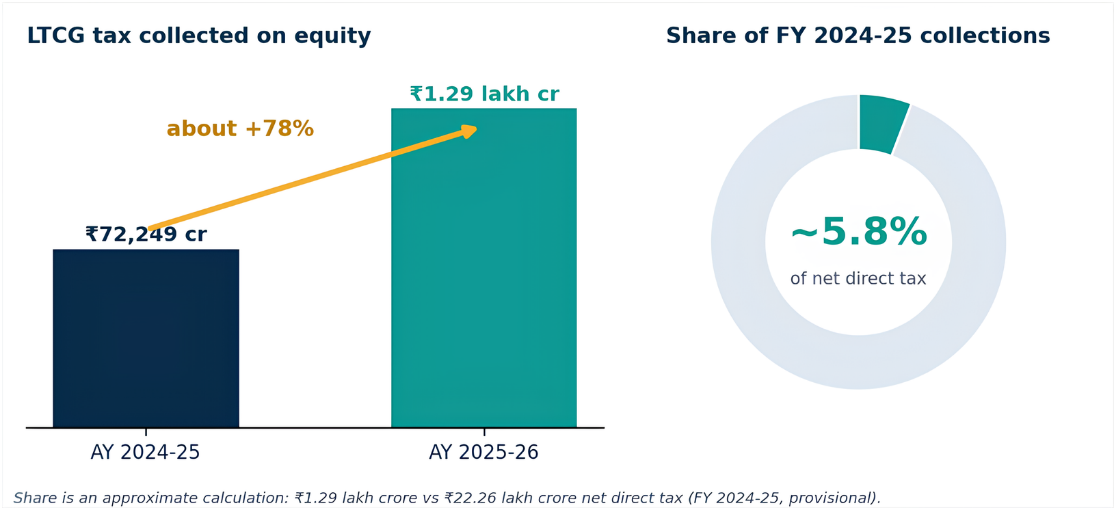
How much has LTCG tax grown over the year? The government told Parliament that it collected ₹1.29 lakh crore in LTCG tax on equity investments in Assessment Year 2025-26, up from ₹72,249 crore in the previous assessment year. That is an increase of about ₹56,909 crore, or roughly 78.8%, so collections nearly doubled in one year.
How much does it contribute to overall tax collections? The net direct tax collection for FY 2024-25 was ₹22.26 lakh crore, and the gross collection was ₹27.02 lakh crore. On that basis, LTCG on equity contributed roughly 5.8% of net direct tax collections and about 4.8% of gross direct tax collections.
What does market activity look like? Securities Transaction Tax (STT) grew 55.87% to ₹53,296 crore in FY 2024-25. STT collections stood at ₹57,522 crore in FY 2025-26.
What changed in the rules? From 23 July 2024, the long-term capital gains tax on listed equity rose to 12.5% from 10%, and the exemption limit rose to ₹1.25 lakh from ₹1 lakh.
Sources: Ministry of Finance reply in Parliament, as reported by ANI; CBDT provisional direct tax data for FY 2024-25, as reported by PTI; Income Tax Department; Business Standard. Share of collections is an approximate calculation.
How Is LTCG Calculated?
Capital Gains Tax Calculation with an Example
Calculating capital gains starts with the amount received from the sale and the eligible costs that can be deducted.
Capital gain = Sale consideration − Eligible acquisition cost − Other permitted deductions
For example, suppose you purchased shares for ₹1,00,000 and later sold them for ₹1,60,000. Assuming no other eligible costs or adjustments, your capital gain would be ₹60,000.
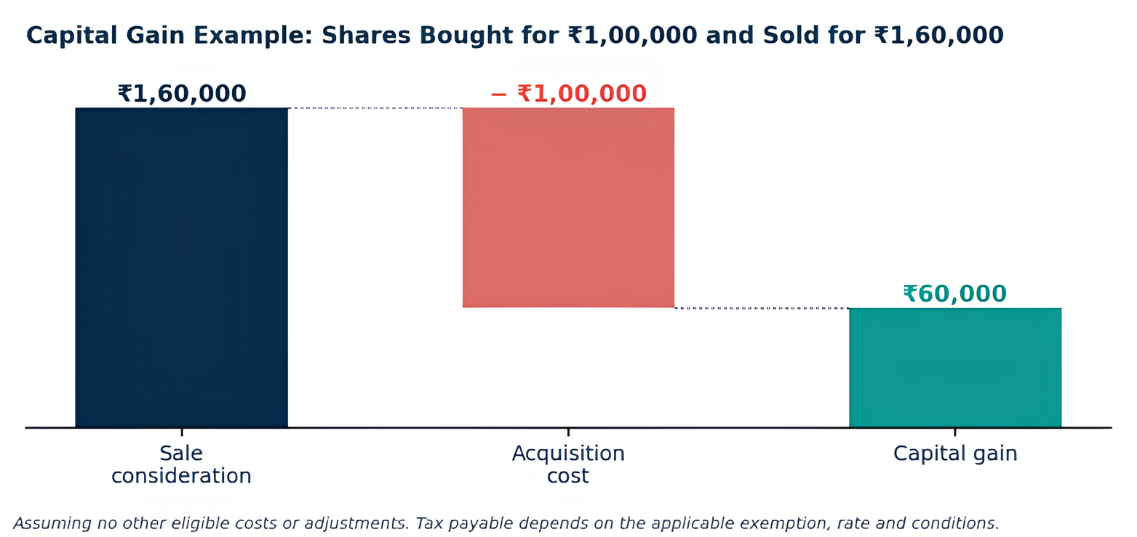
But this does not automatically mean you owe tax on the entire amount. The applicable exemption, tax rate and other conditions determine the final tax payable.
For property, eligible improvement costs and transfer expenses may also affect the calculation.
Source: Income Tax Department — Capital Gains
Can You Reduce LTCG Tax?
LTCG Exemptions on the Sale of Residential Property
Some capital gains qualify for exemptions, but the conditions depend on the asset and the relevant tax provision.
For example, certain gains from selling a residential property may qualify for exemption when the proceeds or gains are reinvested in eligible assets within the prescribed conditions and time limits.
Source: Income Tax Department — Capital Gains and Exemptions
What Should Investors Consider Before Selling?
Before You Sell Equity Shares, Mutual Funds or Property
Before selling an investment, look beyond the profit shown in your portfolio.
Check the holding period, purchase cost, applicable tax rate and any exemption you may qualify for. If you hold different types of investments, such as equity shares, investment funds or property, each may need a separate calculation.
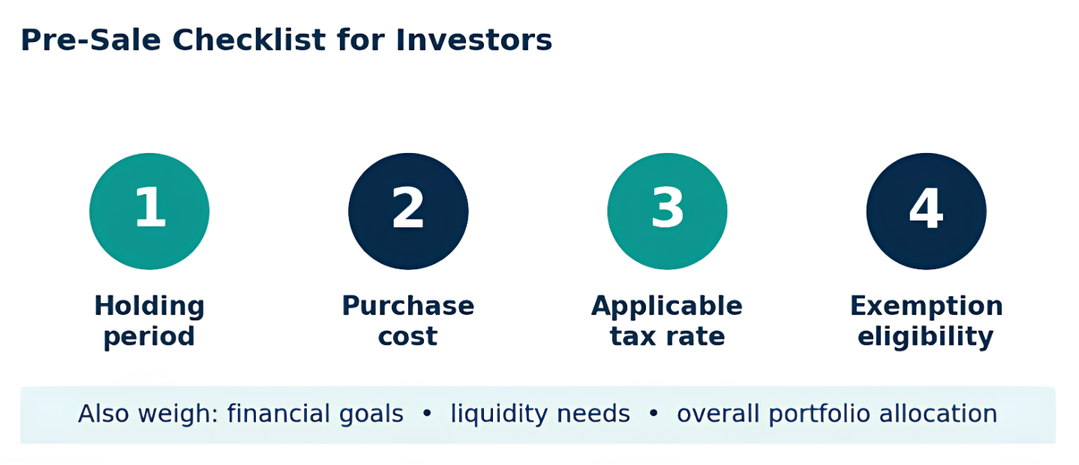
Tax is one part of an investment decision, alongside your financial goals, liquidity needs and overall portfolio allocation.
Key Takeaways
- A capital gain is the profit on selling an asset; it may qualify as a long-term capital gain (LTCG) when the required holding period is met.
- Listed equity shares and equity-oriented mutual funds generally need a holding period of more than 12 months; land and buildings generally need more than 24 months.
- Qualifying LTCG on listed equity shares under Section 198 is taxed at 12.5% on gains exceeding ₹1.25 lakh in a tax year.
- Land and buildings are generally taxed at 12.5% without indexation for transfers on or after 23 July 2024.
- Certain specified debt mutual funds acquired on or after 1 April 2023 are generally taxed at the applicable income-tax slab rate, regardless of holding period.
- An exemption on reinvestment is not automatic; check your eligibility first.
Frequently Asked Questions on LTCG Tax
- What is long-term capital gains tax in India?
When you sell an asset such as shares, a mutual fund or property with a profit, the profit is a capital gain. If the asset meets the required holding period under tax rules, it may qualify as a long-term capital gain (LTCG), and long-term and short-term gains can be taxed differently. - What is the holding period for LTCG on shares and property?
Listed equity shares and equity-oriented mutual funds generally qualify as long-term when held for more than 12 months. Land and buildings generally require a holding period of more than 24 months. - What is the LTCG tax rate on equity shares?
Qualifying LTCG on listed equity shares under Section 198 is taxed at 12.5% on gains exceeding ₹1.25 lakh in a tax year. Equity mutual funds generally follow the same Section 112A rate and threshold, subject to conditions. - How is LTCG calculated?
Capital gain = Sale consideration − Eligible acquisition cost − Other permitted deductions. The applicable exemption, tax rate and other conditions then determine the final tax payable. - Can you reduce LTCG tax on the sale of a residential property?
Certain gains from selling a residential property may qualify for exemption when the proceeds or gains are reinvested in eligible assets within the prescribed conditions and time limits. An exemption is not automatic simply because the money is invested again. - Do specified debt mutual funds get long-term tax treatment?
Not automatically. Certain funds acquired on or after 1 April 2023 are subject to special rules under which gains are generally taxed at the applicable income-tax slab rate, regardless of holding period.
Know Your Real LTCG Tax Liability Before You Sell
Your portfolio may hold equity shares, mutual funds, investment funds and property, and each can be taxed differently. Instead of checking every holding one by one, get a complete view in one place.
Analyse your current portfolio with Finideas:
- Connect through Account Aggregator: Securely share your financial data, only with your consent, and see your overall portfolio together.
- Understand your position: Review your holdings and holding periods before you decide what to sell.
Disclaimer: This article is for educational purposes only and does not constitute tax or investment advice. Tax treatment depends on the asset, transaction date and individual circumstances. Please consult a qualified tax professional for advice specific to your situation.